
The Family Court of Australia must be satisfied that you and your spouse have lived separately for at least 12 months. There must also be no likelihood of resuming married life. There’s no official process for establishing a separation date. However, a separation can be demonstrated in various ways, including:
- Informing family and friends;
- Informing government agencies such as Centrelink;
- Living in separate residences;
- Maintaining separate social circles;
- Separating finances such as closing joint bank accounts.
Separation under one roof
The Court recognises that not everyone can live at a different residence. To account for this, it recognises the ability of couples to be “separated under one roof“. The most important thing is to demonstrate that you are living separate lives. The best way to do this is to fill out an affidavit describing how your separation works. Some factors the Court will consider include the following:
- Sleeping in different bedrooms;
- Cessation of all sexual contact;
- Not eating meals together;
- Splitting household chores.

Necessary documentation
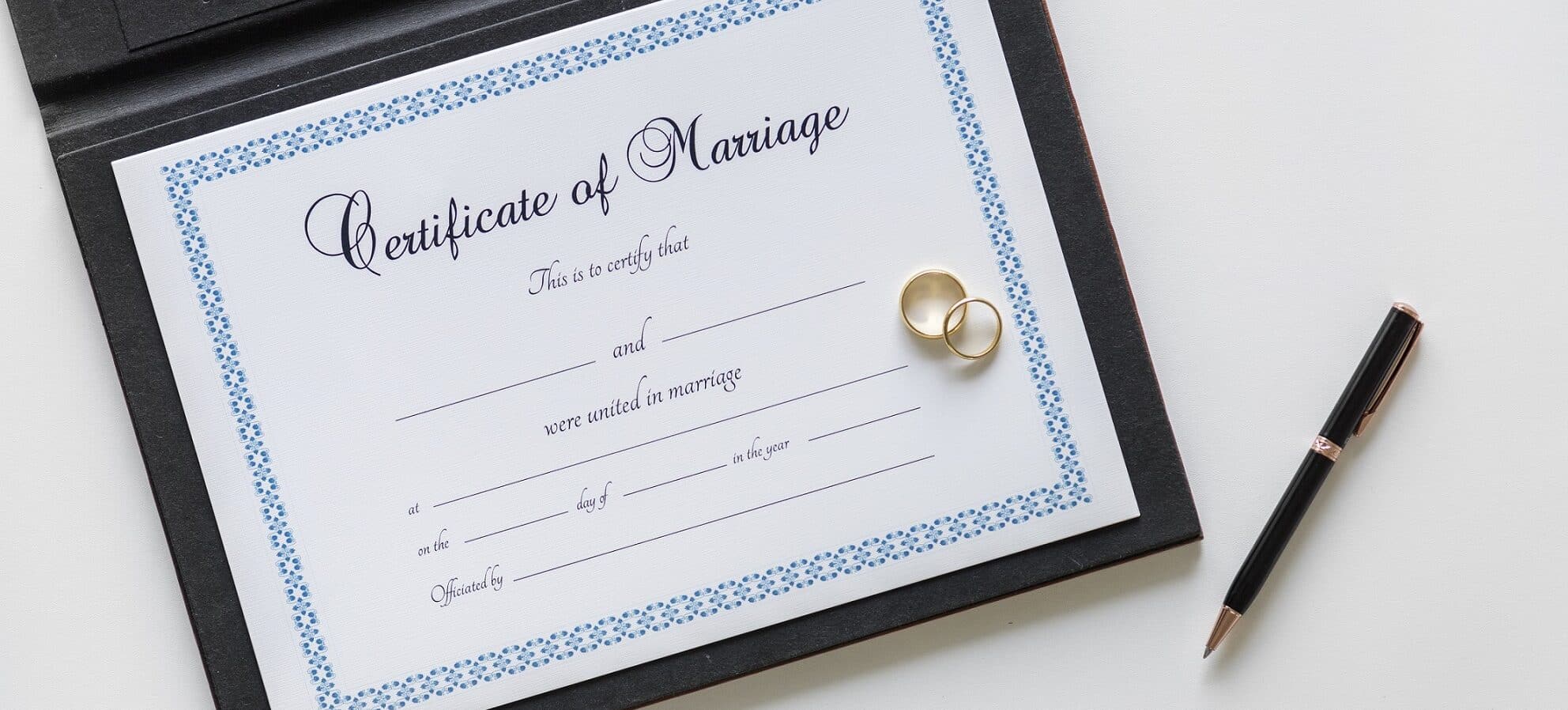
The primary document required for a divorce filing is your marriage certificate. If you have been separated for 12 months, this document is essential to confirm the validity of your marriage before filing for divorce. If you have been married for less than two years, you may need to file a counselling certificate to demonstrate you attempted reconciliation.
If you have lost your original marriage certificate, you will need to file a replacement, which can be obtained from the Registry of Births, Deaths, and Marriages for a fee.
You will need an English translation if you were married overseas and your marriage certificate is in a foreign language. The translation must be from a service recognised by the National Accreditation Authority for Translators and Interpreters. The translator will provide:
- A translated copy of your marriage certificate;
- A completed Affidavit Translation of Marriage Certificate;
- A document setting out their qualifications to make the translation.
The Affidavit Translation of Marriage Certificate must be filed with your divorce. You will also need to provide payment using a debit card, and if applicable, a counselling certificate. Fee reductions may be available for eligible applicants.
If you have children under 18, you must provide evidence of proper care, welfare, and development arrangements. This may include parenting arrangements and property settlement details. Payment for the divorce can be made using a debit card. Proper documentation ensures a smoother divorce process when applying for your divorce.
Once you’ve gathered your documentation, you can start the divorce process. You can apply for a divorce online through the Federal Circuit and Family Court of Australia.
Divorce filing
- Register an account on the Commonwealth Courts Portal;
- Select Application for Divorce;
- Complete sections A to F of the application;
- Double-check the information provided and upload supporting documents;
- Print the application and sign the Affidavit for eFiling Application (Divorce);
- If it’s a sole application, only the applicant must sign;
- Both parties must sign before a Justice of the Peace if it’s a joint application.
- Upload the Affidavit for eFiling (Divorce);
- Download the brochure Marriage, Families and Separation;
- Submit the application and pay the filing fee;
- Sole applicants must serve the divorce papers on their spouse.
After filing, a court hearing date will be set. If you’ve made a sole application and there are no children under 18, you don’t need to attend Court. If it’s a joint application, neither party must attend Court unless there are exceptional circumstances.
Following the divorce hearing, the Court will grant a divorce order if all is in order. This order becomes final one month and one day after the divorce hearing. Once finalised, you and your ex-partner can request an official copy of the divorce order, which may be required for updates at the Registry of Births, Deaths, and Marriages or other legal processes.

For the full details on applying for divorce online, read this: How to Apply for Online Divorce? (8 Simple Steps Guide)
Serving Divorce Papers: What You Must Do Next
Sole applicants must serve the divorce petition and related documents on their former partner after submitting it online to the Family Court to proceed with obtaining a divorce order. It is advisable to seek legal advice when applying for a divorce to ensure all requirements are met, and the process runs smoothly.
The documents that you must serve are the following:
- A sealed copy of the divorce with a Notice of Application for Divorce attached;
- A sealed copy of the Affidavit for eFiling;
- An Acknowledgment of Service (Divorce);
- Any supporting documentation related to your application.
There are several ways you can serve documents.
By hand
Service of the divorce documents, which is a necessary step to obtain a divorce order, can be completed by someone over 18. This can include a family member, friend, or other associate. Alternatively, you can hire a professional process server for a fee. It is important to note that the applicant cannot serve the documents personally.
The spouse being served should sign the Acknowledgment of Service, which is a critical step in the process of obtaining a divorce order within the federal circuit and family law system. If the couple has been separated for 12 months, including periods where they lived under one roof, this must be clearly documented. The server must then complete the Affidavit of Service by hand and attach the Acknowledgment of Service. Seeking legal advice can help ensure all steps are completed accurately and in compliance with legal requirements.
If the server does not personally know the respondent, they must also complete an affidavit proving the respondent’s signature. This ensures that the process adheres to the requirements of the family law system.
By post
You should only opt for service by post if you’re confident the respondent will sign and return the Acknowledgment of Service within the required time limits set by the family law system. If the respondent fails to do so, you may need to file additional documents to prove service. Additionally, if your application involves a property settlement, you must apply to have all necessary agreements formalized through the Court.
In addition to the above documents, you must provide clear instructions for the respondent to sign the Acknowledgment, retain a copy of the divorce, and return the signed Acknowledgment.
To facilitate this, include a stamped and self-addressed envelope for the respondent to return the Acknowledgment promptly.
Fill out the Affidavit of Service – by post and attach it to the Acknowledgment of Service. Seeking legal advice can help ensure these documents are completed accurately and comply with all legal requirements.
Serve your spouse’s lawyer.
You can serve your spouse’s lawyer if they accept service. Once the lawyer has completed the Acknowledgment of service correctly, no other documentation is necessary.
Alternative service
If standard service methods aren’t possible, there are alternatives, such as substituted service or dispensation of service. These options can be particularly useful if you are making a joint application or have been separated for 12 months but cannot locate the other party. Seeking legal advice is crucial to understand which option is best for your situation and to ensure compliance with legal requirements. Obtaining professional legal advice can help you navigate these alternatives effectively.
Substituted service
Sometimes, you may have difficulty contacting your ex-partner for service. In such cases, the Court may grant substituted service as part of the divorce filing process. When applying for a divorce, it is crucial to seek legal advice to understand the options available under family law. Substituted service allows the required documents to be delivered in an alternative manner approved by the Court. Depending on the circumstances, you may also need to attend a Court hearing to finalise this process.
This allows you to serve someone you are confident will bring the application to the respondent’s attention. Typically, this will be a family member, friend, or co-worker. Seeking legal advice can help ensure the service process is carried out correctly and complies with legal requirements. Obtaining professional legal advice is crucial to avoid delays or complications in your application.
Dispensation of service
If the Court is satisfied that you have exhausted all reasonable efforts to contact your spouse, it may grant a dispensation of service. This allows you to proceed with your divorce application without completing the usual service requirements.
When applying for a divorce, it is essential to seek legal advice to ensure you meet the necessary criteria under family law. In some cases, you may need to attend a Court hearing to explain your efforts to locate your spouse and justify the request. Dispensation of service provides an alternative pathway to apply for a divorce when traditional service is not possible.